Womic Stainless Steel Co., Ltd

Thestainless steel pipe priceis one of the most important considerations for industrial buyers, project contractors, and distributors. Stainless steel pipes are widely used in industries such as oil and gas, chemical processing, marine engineering, power generation, food processing, and water treatment systems. Because these pipes must withstand demanding operating conditions including high pressure, corrosive environments, and extreme temperatures, the materials used and the manufacturing processes involved can significantly influence the final cost.
In the global steel market, stainless steel pipe prices fluctuate due to several factors, including raw material costs, alloy composition, production methods, pipe dimensions, inspection requirements, and supply chain conditions. Buyers who understand these price drivers can make better procurement decisions and choose a reliablestainless steel pipe supplierthat offers both competitive pricing and consistent product quality.
This guide explains the major factors that affect thestainless steel pipe price, helping buyers evaluate quotations more accurately and optimize purchasing strategies.
The most significant factor influencing stainless steel pipe prices is the cost of raw materials. Stainless steel is an alloy primarily composed of iron, chromium, nickel, and sometimes molybdenum or nitrogen. The proportion of these alloying elements determines both the corrosion resistance and the price of the material.
Among these elements,nickel and molybdenum are the most expensive components, and their global market prices fluctuate frequently. When nickel prices rise, the cost of stainless steel production increases accordingly, which directly affects the stainless steel pipe price.
For example:
304 stainless steel
pipes typically contain around 8–10% nickel.
316 stainless steel pipes contain approximately 10–14% nickel and 2–3%
molybdenum.
Because of the additional molybdenum content,316 stainless steel pipes are usually more expensive than 304 stainless steel pipes.
Other specialized stainless steel grades such as duplex stainless steel or super austenitic stainless steel contain higher alloy content, which further increases material costs.
Different stainless steel grades are designed for different industrial environments, and their chemical compositions significantly affect the stainless steel pipe price.
Below are common stainless steel pipe materials and their relative price levels.
|
Stainless Steel Grade |
Typical Application |
Relative Price Level |
|
201 |
Decorative pipes |
Low |
|
304 / 304L |
General industrial pipelines |
Medium |
|
316 / 316L |
Chemical and marine pipelines |
Medium-High |
|
321 |
High temperature pipelines |
High |
|
Duplex 2205 |
Offshore and chemical plants |
High |
|
Super Duplex 2507 |
Offshore platforms |
Very High |
|
254SMO |
Seawater and desalination plants |
Premium |
For example, duplex stainless steel pipes provide higher strength and corrosion resistance than standard austenitic grades, but their price is typically30–60% higher than 316L pipes.
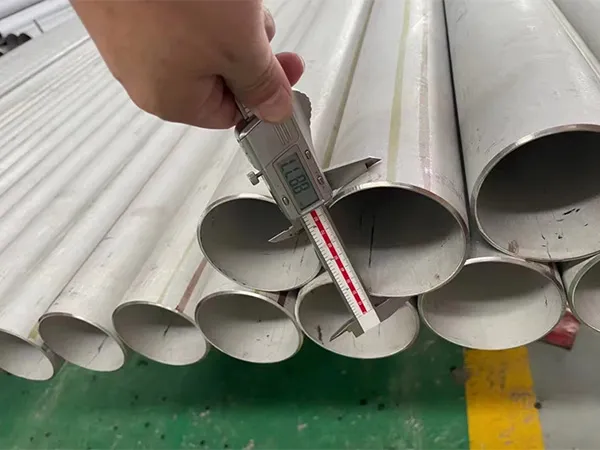
Another major factor influencing stainless steel pipe prices is the pipe dimension. Bothouter diameter (OD)andwall thickness (WT)directly determine the amount of raw material used.
Larger pipes require more stainless steel material, which increases production cost. Pipes with thicker walls also consume more material and require greater forming force during manufacturing.
Typical stainless steel pipe dimensions include:
Outer diameter ranging
from 6 mm to over 2000 mm
Wall thickness ranging from 0.5 mm to over 50 mm
As the pipe diameter and thickness increase, the stainless steel pipe price rises proportionally.
For example:
A 1-inch stainless
steel pipe will cost significantly less than a 12-inch pipe of the same grade.
Similarly, a pipe with SCH 40 wall thickness will be cheaper than a pipe with
SCH 160 thickness.
Therefore, when requesting quotations, buyers should always specify accurate pipe dimensions.
The manufacturing process used to produce stainless steel pipes also has a major impact on price.
Seamless pipes are produced through hot piercing and rolling processes. Because they are manufactured without a welded seam, they offer superior structural integrity and pressure resistance.
However, seamless pipe production involves more complex manufacturing steps and higher energy consumption, which increases production costs.
Typical characteristics include:
Higher production cost
Better pressure resistance
Uniform mechanical properties
Seamless stainless steel pipes are commonly used in:
Oil and gas pipelines
High-pressure chemical systems
Boiler and heat exchanger systems
Welded stainless steel pipes are manufactured by forming stainless steel plates or coils and joining them through welding processes.
Compared with seamless pipes, welded pipes generally have:
Lower production costs
Greater diameter flexibility
Better cost efficiency for large pipes
They are widely used in:
Water pipelines
Structural systems
Low-pressure industrial piping
For large diameter pipelines, welded stainless steel pipes usually provide the most economical solution.
Production methods also influence stainless steel pipe price.
Hot rolling is commonly used for large diameter pipes. The process involves heating stainless steel billets and rolling them into pipe shapes.
Advantages include:
High production
efficiency
Lower manufacturing cost
Suitable for large diameter pipes
Cold drawing is used to produce pipes with high dimensional accuracy and smoother surface finish.
Advantages include:
Better dimensional
tolerance
Improved mechanical properties
Smooth surface quality
However, cold drawn pipes require additional processing steps, which increases manufacturing cost.
Many stainless steel pipes must undergo heat treatment to achieve the required mechanical properties and corrosion resistance.
Common heat treatment processes include:
Solution annealing
Stress relieving
Quenching
Solution annealing is especially important for austenitic stainless steels such as 304 and 316, as it dissolves carbides and restores corrosion resistance.
Heat treatment requires specialized equipment and additional energy consumption, which contributes to the final stainless steel pipe price.
Industrial pipeline projects often require strict inspection procedures to ensure material quality.
Typical tests include:
Chemical composition
analysis
Mechanical property testing
Hydrostatic testing
Ultrasonic testing
Radiographic testing
Additional inspection requirements increase manufacturing costs, which may affect the stainless steel pipe price.
However, these inspections are essential for ensuring product safety and reliability.
Order quantity can significantly influence the unit price of stainless steel pipes.
Large volume orders usually result in lower production costs because manufacturers can optimize production efficiency and reduce setup time.
For example:
Small batch orders
often have higher unit prices due to production adjustments.
Large project orders allow manufacturers to offer more competitive pricing.
Therefore, buyers planning large projects may benefit from negotiating long-term supply agreements with a reliablestainless steel pipe supplier.
The stainless steel pipe market is influenced by global economic conditions and supply chain factors.
Key influences include:
Nickel price
fluctuations
Energy costs
Shipping and logistics costs
International steel demand
Exchange rate changes
When raw material prices rise, stainless steel pipe prices usually increase accordingly. Conversely, during periods of lower demand, suppliers may offer more competitive pricing.
Shipping costs also contribute to the final price of stainless steel pipes.
Transportation costs depend on several factors:
Shipping distance
Packaging method
Container or bulk shipment
Port handling charges
For international buyers, selecting a supplier with strong export logistics experience can help reduce shipping costs and ensure safe delivery.
Industrial buyers can optimize procurement costs by following several strategies.
1 Work with experienced
stainless steel pipe suppliers
2 Compare quotations from multiple manufacturers
3 Clearly define technical specifications
4 Plan orders in advance to avoid urgent production costs
5 Consider long-term supply agreements
A reliable supplier will not only offer competitive stainless steel pipe prices but also ensure consistent product quality and delivery reliability.
Womic Steel is a professional stainless steel pipe manufacturer supplying high-quality pipes to global industrial markets.
Our production capabilities include:
Seamless stainless
steel pipes (OD 1/4" – 36")
Welded stainless steel pipes (OD up to 80")
Duplex stainless steel pipes
Super duplex stainless steel pipes
Super austenitic stainless steel pipes
We manufacture pipes according to international standards including:
ASTM
ASME
EN specifications
Our advantages include:
Advanced manufacturing
equipment
Strict quality control systems
Competitive stainless steel pipe prices
Stable raw material supply chains
Professional export logistics services
These strengths enable us to provide reliable stainless steel pipe solutions for global industrial projects.
Customized services. Rapid production. Global reach. We ensure your specific needs are fulfilled with precision and top-tier quality.
Website: www.womicstainless.com
Email:info@womicstainless.com
Tel/WhatsApp/WeChat:Victor: +86-15575100681 or Jack: +86-18390957568