Womic Stainless Steel Co., Ltd

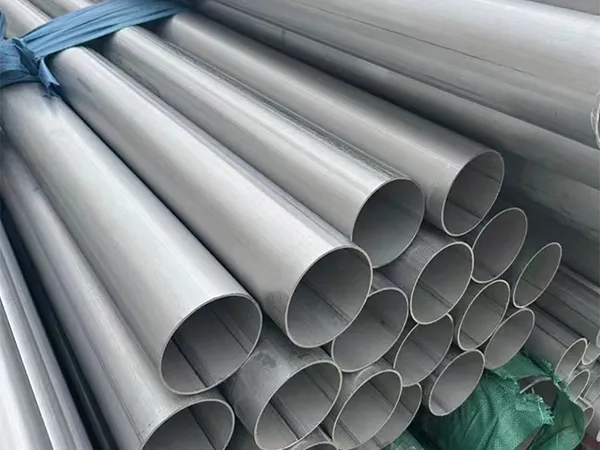
Welded stainless steel pipes are widely used in industrial piping systems due to their excellent corrosion resistance, reliable mechanical properties, and cost-effective manufacturing process. Compared with seamless pipes, welded stainless steel pipes are typically more economical for large diameter pipelines and long-distance fluid transportation systems.
Modern welded stainless steel pipes are manufactured using advanced forming and welding technologies that ensure high structural integrity and consistent weld quality. Through precise welding processes and strict inspection procedures, welded pipes can achieve performance levels comparable to seamless pipes in many industrial applications.
Welded stainless steel pipes are commonly used in industries such as oil and gas transportation, chemical processing, water treatment, marine engineering, heat exchanger systems, and structural engineering projects.
At Womic Steel, welded stainless steel pipes are manufactured using advanced welding technologies including ERW welding, TIG welding, and submerged arc welding. These technologies ensure high-quality weld seams and reliable performance in demanding industrial environments.
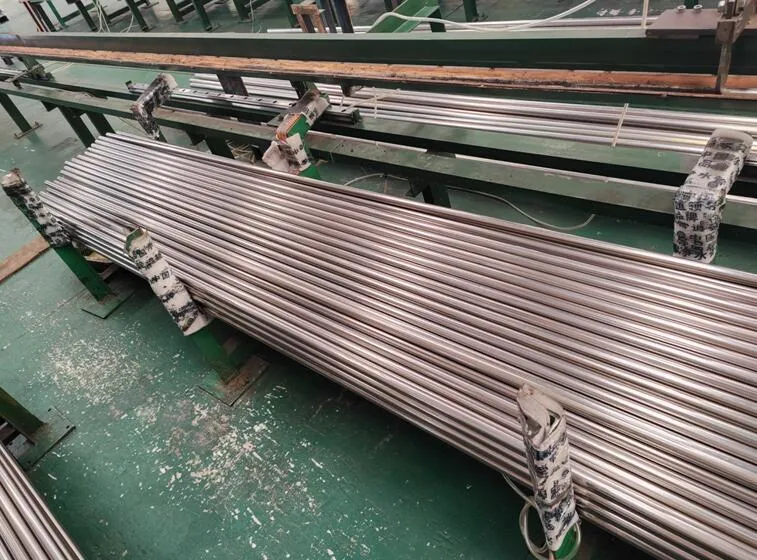
The production of welded stainless steel pipes begins with high-quality stainless steel plates or coils. These materials are typically produced through hot rolling or cold rolling processes depending on the required pipe specifications.
Stainless steel coils used for pipe manufacturing must meet strict requirements for chemical composition, thickness tolerance, and surface quality. Common stainless steel grades used in welded pipe production include 304, 304L, 316, 316L, 316Ti, and duplex stainless steels such as 2205.
Before entering the pipe forming process, stainless steel coils undergo inspection procedures to verify thickness uniformity, mechanical properties, and surface condition. Any defects in the raw material can affect weld quality and overall pipe performance.
Careful selection and preparation of raw materials ensure that the welded stainless steel pipes meet international standards such as ASTM A312, ASTM A358, and EN 10217-7.
Once the stainless steel coil is prepared, it is fed into a pipe forming line where it is gradually shaped into a cylindrical pipe.
The coil first passes through a series of forming rollers that bend the flat strip into a round shape. Each roller set gradually increases the curvature until the edges of the strip meet to form a tubular structure.
The forming process must be carefully controlled to ensure proper alignment of the pipe edges before welding. Poor edge alignment can lead to welding defects such as incomplete fusion or misalignment of the weld seam.
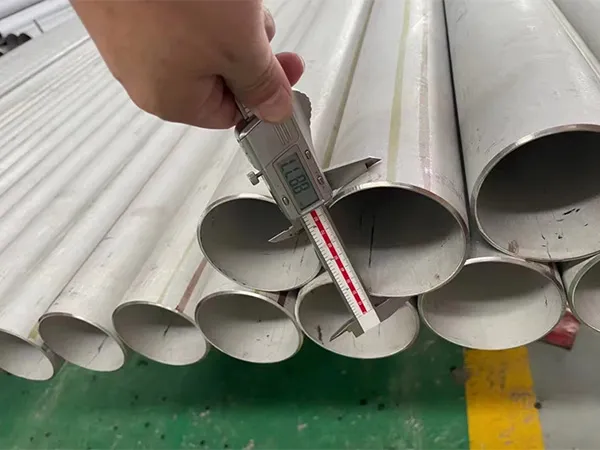
Advanced forming equipment allows manufacturers to produce pipes with precise outer diameter dimensions and consistent wall thickness distribution.
Electric Resistance Welding (ERW) is one of the most widely used methods for manufacturing welded stainless steel pipes.
In the ERW process, the edges of the formed pipe are heated using high-frequency electrical current. As the edges reach the required temperature, pressure rollers press them together to create a solid-state weld.
Unlike traditional welding methods, ERW does not require filler material. The heat generated by electrical resistance melts the edges of the stainless steel strip, allowing them to fuse together.
High-frequency ERW welding provides several advantages, including high production speed, consistent weld quality, and excellent dimensional control. The weld seam produced by ERW welding is strong and reliable when proper process control is maintained.
ERW welded stainless steel pipes are commonly used in water pipelines, structural applications, and industrial fluid transport systems.
Tungsten Inert Gas (TIG) welding is another widely used welding technology for stainless steel pipe production. This process is often used for high-precision welded pipes and pipes used in critical industrial applications.
In TIG welding, an electric arc is generated between a tungsten electrode and the pipe edges. An inert shielding gas, usually argon, protects the molten weld pool from atmospheric contamination.
TIG welding produces extremely clean and precise weld seams with excellent corrosion resistance. Because of its high weld quality, TIG welding is commonly used for stainless steel pipes used in chemical plants, pharmaceutical manufacturing, food processing systems, and heat exchanger tubing.
Although TIG welding has a slower production speed compared with ERW welding, it provides superior weld integrity for high-performance piping systems.
For large diameter stainless steel pipes, submerged arc welding (SAW) is commonly used. This welding method is particularly suitable for thick-walled pipes used in industrial pipelines.
During the SAW process, the welding arc is submerged beneath a layer of granular flux. The flux protects the weld area from atmospheric contamination while stabilizing the welding arc.
Submerged arc welding allows deep weld penetration and strong weld joints, making it suitable for large diameter pipes used in oil and gas transportation pipelines and industrial processing facilities.
Both longitudinal submerged arc welding (LSAW) and spiral submerged arc welding (SSAW) may be used depending on the pipe design requirements.
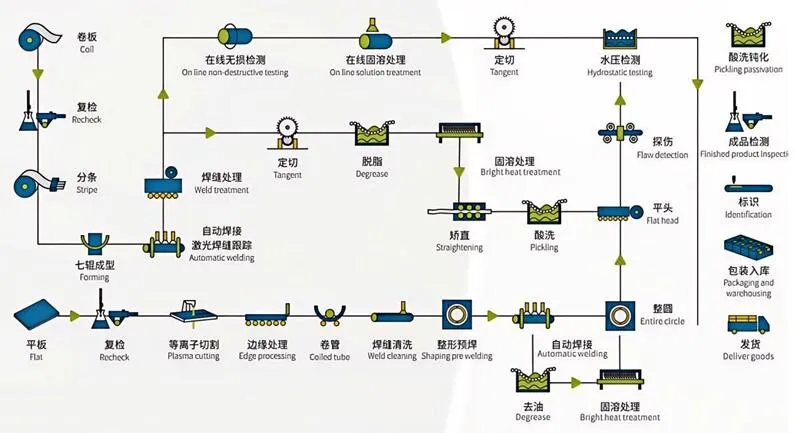
After the welding process is completed, certain stainless steel pipes may undergo heat treatment to improve weld performance and eliminate residual stresses.
Solution annealing may be applied to restore corrosion resistance in the weld zone and ensure uniform microstructure throughout the pipe. Heat treatment also reduces residual stresses generated during the welding process.
Controlled heating and cooling cycles ensure that the welded pipe maintains its mechanical properties and corrosion resistance.
Quality inspection is essential in welded stainless steel pipe manufacturing to ensure weld integrity and structural reliability.
Non-destructive testing methods are widely used to detect internal and surface defects in the weld seam. These methods include ultrasonic testing, radiographic testing, and eddy current testing.
Ultrasonic testing is commonly used to detect internal weld defects such as lack of fusion or inclusions. Radiographic testing uses X-ray imaging to inspect the internal structure of the weld.
Eddy current testing can identify surface cracks or discontinuities in the pipe body and weld seam.
Through comprehensive testing procedures, manufacturers ensure that welded stainless steel pipes meet strict quality requirements for industrial use.
Welded stainless steel pipes are widely used in industries that require corrosion-resistant piping systems.
In the chemical industry, these pipes are used for transporting acids, solvents, and chemical processing fluids. In water treatment plants, welded stainless steel pipes are used in filtration systems and water distribution networks.
Marine engineering applications also rely on welded stainless steel pipes for seawater transport systems and structural components exposed to marine environments.
Heat exchanger systems frequently use welded stainless steel tubing due to its excellent corrosion resistance and thermal performance.
Because of their versatility and cost efficiency, welded stainless steel pipes are widely used across many industrial sectors.
Womic Steel manufactures high-quality welded stainless steel pipes using advanced forming equipment and modern welding technologies. The company produces a wide range of pipe sizes and stainless steel grades to meet various industrial requirements.
With experienced engineers, strict quality control procedures, and advanced inspection systems, Womic Steel ensures that every welded stainless steel pipe meets international standards and project specifications.
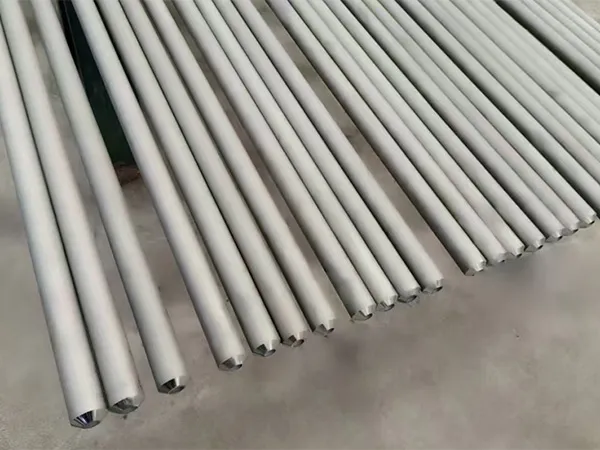
The company provides customized production services including special pipe dimensions, surface finishes, and additional processing such as pipe cutting and beveling.
Through reliable production capacity and efficient global logistics networks, Womic Steel supplies stainless steel pipes to customers worldwide in industries including energy, chemical processing, marine engineering, and infrastructure construction.
Customized services. Rapid production. Global reach. We ensure your specific needs are fulfilled with precision and top-tier quality.
Website: www.womicstainless.com
Email:info@womicstainless.com
Tel/WhatsApp/WeChat:Victor: +86-15575100681 or Jack: +86-18390957568