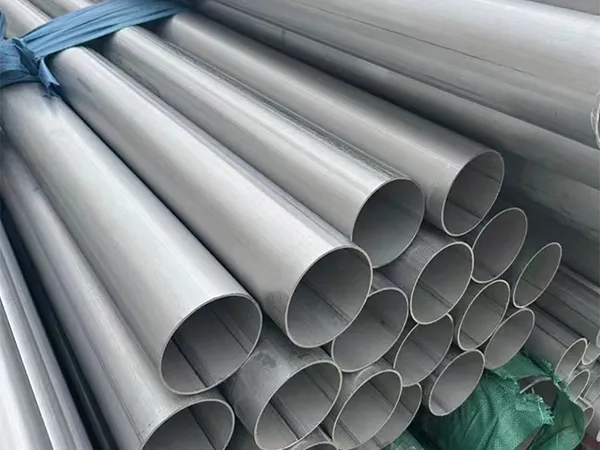
Womic Stainless Steel Co., Ltd

Welded stainless steel pipes are one of the most widely used stainless steel pipe products in modern industrial applications. Compared with seamless pipes, welded pipes offer advantages such as higher production efficiency, lower manufacturing cost, and greater flexibility in producing large diameters and thin wall pipes.
The manufacturing process of welded stainless steel pipes involves forming stainless steel strip or plate into a cylindrical shape and joining the edges together through a welding process. Advanced welding technologies ensure that the weld seam has mechanical properties and corrosion resistance comparable to the base metal.
Because of these improvements in welding technology, welded stainless steel pipes are now widely used in industries such aspetrochemical processing, oil and gas transportation, water treatment systems, food processing facilities, construction engineering, and mechanical manufacturing.
At Womic Steel, welded stainless steel pipes are manufactured using modern forming equipment and precision welding technology to ensure consistent product quality and compliance with international standards.
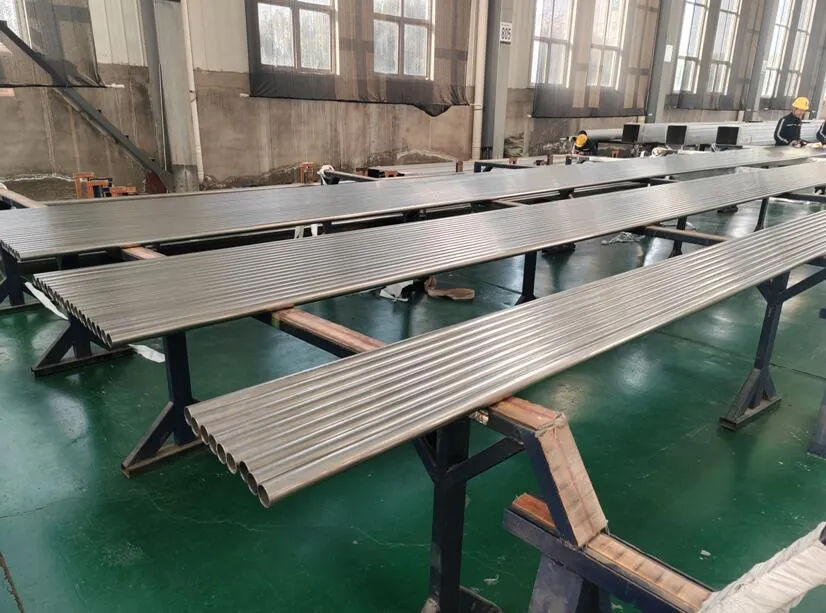
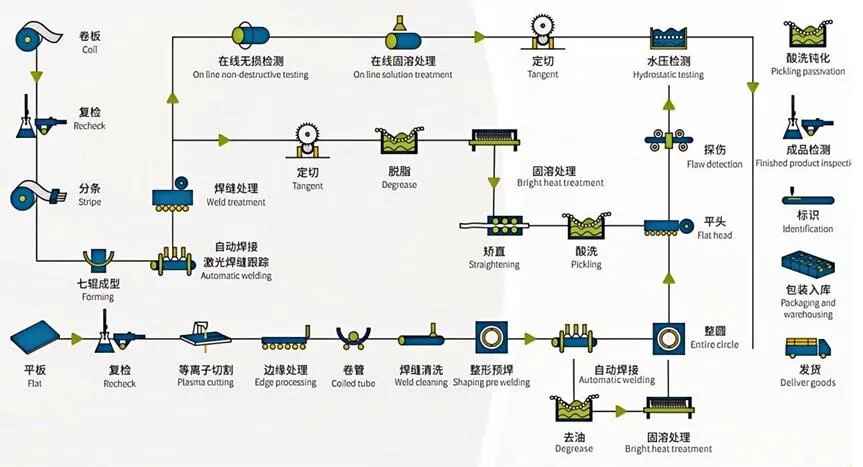
The production of welded stainless steel pipes begins with high-quality stainless steel coils or plates. These raw materials must meet strict chemical composition requirements to ensure the finished pipes achieve the required corrosion resistance and mechanical strength.
Common stainless steel grades used for welded pipe production include304, 304L, 316, 316L, 321, 347H, 310S, and other corrosion-resistant stainless steel alloys.
Before entering the pipe forming line, stainless steel coils undergo several inspection procedures including surface examination, thickness measurement, and chemical composition verification.
Any surface defects such as cracks, scratches, or inclusions must be removed before the forming process begins. Proper raw material preparation ensures stable welding quality and prevents defects in the finished pipes.
Large stainless steel coils are usually slit into narrower strips according to the required pipe diameter and wall thickness. This process is performed using precision slitting machines that cut the coil into strips with controlled width tolerances.
The strip width directly determines the pipe circumference after forming. Therefore, accurate slitting is essential to maintain dimensional consistency during pipe manufacturing.
Edge quality is also important during this stage. Clean and smooth strip edges help ensure high-quality weld seams during the welding process.
After slitting, the stainless steel strip enters the pipe forming section. In this stage, a series of forming rollers gradually bend the flat strip into a cylindrical shape.
The forming process occurs in multiple stages. Each roller set gradually increases the curvature of the strip until the edges approach each other to form a nearly closed tube.
Precise alignment of the strip edges is critical at this stage. Proper edge alignment ensures that the welding process produces a uniform and defect-free weld seam.
Modern pipe forming lines use automated roller adjustment systems to maintain consistent forming accuracy throughout the production process.
One of the most common welding methods used in stainless steel pipe production ishigh-frequency induction welding (HFIW).
During this process, high-frequency electrical current is applied to the edges of the formed pipe. The electrical resistance generates localized heat at the strip edges, bringing them to the welding temperature.
Pressure rollers then compress the heated edges together, creating a solid-state weld seam without the need for filler metal.
High-frequency welding offers several advantages including high welding speed, narrow heat-affected zones, and excellent weld quality.
This process is widely used for producing stainless steel pipes for industrial piping systems, structural applications, and fluid transportation pipelines.
After welding, the weld bead formed on the outer surface of the pipe must be removed to create a smooth and uniform surface.
Grinding machines are used to remove the excess weld material and restore the pipe’s cylindrical shape. Internal weld bead removal may also be required for certain applications, especially in industries where fluid flow must remain unobstructed.
Proper weld seam treatment improves both the mechanical performance and the appearance of the finished pipe.
Heat treatment is an important step in welded stainless steel pipe production. The welding process introduces thermal stresses and microstructural changes that must be controlled to maintain corrosion resistance.
Solution annealing is commonly used for austenitic stainless steel pipes such as304 and 316 grades.
During solution annealing, the pipe is heated to a high temperature and then rapidly cooled to dissolve chromium carbides and restore corrosion resistance.
Proper heat treatment ensures that the weld seam and base material have uniform mechanical properties and corrosion resistance.
After welding and heat treatment, the pipes pass through sizing mills that adjust the final outer diameter and improve dimensional accuracy.
Straightening machines are also used to correct any pipe curvature that may have occurred during the forming and welding processes.
Accurate sizing ensures that the pipes meet dimensional tolerance requirements specified by international standards such as ASTM and EN specifications.
Welded stainless steel pipes may undergo several surface finishing processes depending on the application requirements.
Pickling is commonly used to remove oxide scale and heat tint generated during welding and heat treatment. The pickling process restores the natural corrosion resistance of stainless steel.
Additional surface finishing methods such as polishing or passivation may also be applied for applications requiring enhanced surface quality.
These treatments are particularly important in industries such asfood processing, pharmaceutical production, and high-purity chemical processing.
Quality assurance is a critical part of welded stainless steel pipe manufacturing. Several non-destructive testing methods are used to ensure weld integrity and material quality.
Ultrasonic testing is commonly used to detect internal defects in the weld seam. Eddy current testing is used to identify surface defects or discontinuities.
Hydrostatic pressure testing is also performed to verify the pipe’s ability to withstand internal pressure.
These testing methods ensure that welded stainless steel pipes meet strict quality requirements for industrial applications.
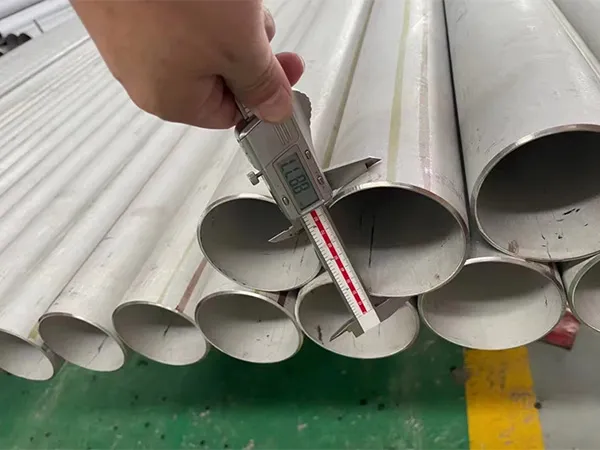
In addition to non-destructive testing, pipes undergo dimensional inspection to verify outer diameter, wall thickness, length, and straightness.
Mechanical property testing may include tensile testing and hardness testing depending on the relevant specification requirements.
These tests confirm that the pipes meet the mechanical performance standards required for industrial piping systems.
Welded stainless steel pipes are used in a wide range of industries due to their excellent corrosion resistance and cost efficiency.
Typical applications includewater treatment systems, food processing pipelines, chemical processing plants, architectural structures, and mechanical equipment manufacturing.
Large diameter welded pipes are also commonly used in municipal infrastructure projects and offshore engineering applications.
Because welded pipes can be produced in long lengths and large diameters, they are particularly suitable for pipeline systems that require efficient installation.
Womic Steel is a professional manufacturer of stainless steel pipes with extensive experience in welded pipe production.
The company operates advanced pipe forming lines equipped with high-frequency welding systems and automated quality inspection equipment. These facilities enable Womic Steel to produce stainless steel pipes with stable quality and consistent performance.
Strict quality control procedures ensure that every pipe meets international standards such as ASTM, EN, and ASME specifications.
Womic Steel also provides customized manufacturing services for customers requiring special pipe dimensions, stainless steel grades, or additional testing procedures.
With strong manufacturing capability and global logistics experience, Womic Steel supplies welded stainless steel pipes to customers in energy, chemical processing, infrastructure construction, and industrial manufacturing sectors around the world.